Friday, October 17, 2008

Sounds of Nicaragua

Hi again, I've recorded some interesting, funny, amazing videos of Nicaragua and every once in awhile I'm going to post one or two on my blog.  An ongoing novela of sorts.  Enjoy.

Walking to El Roblar:


Rain on a tin roof:

Sunday, October 12, 2008

What we're doing

Hi again,  sorry it has taken me so long to update my blog.  I guess we've been kind of busy, a lot of traveling to different communities to get the foundations laid out for the upcoming projects.  Overall things are going well, both with work and socially.  I've met some nice people down here to hang out with and I don't quite feel as isolated anymore.  I am though considering buying a motorcycle to get around a little easier, the bus system, while adequate, can be quite agonizing at times.  Also, I figure if I can survive the streets of Managua on a motorcycle I can survive just about anything.

Some people have asked for some more information on the specific projects that I'll be working on over the next few months so I thought I'd take this opportunity to spread a little more light on what we're doing.

Project #1: Solar Water Pump in Sonzapote

Sonzapote is a community of around 350 people.  They are located in a somewhat remote and isolated area of Boaco and currently have to access to running water 
or electricity.  They're sources of water currently include two public wells and a some privately owned wells as well.  Much of the community is located in a part known as "Arriba" and they have to carry their water almost half a mile up a 300 ft climb (when I climbed this myself, with no load to carry I was sweating and out of breath).

So Asofenix has committed to installing a solar water pumping system comprised of 2 tanks that will deliver water to all 70+ houses.  The system will operate by locating a the largest tank above the community and then gravity feeding the water to the community.

So far the well has been dug and the pump/tubes/solar panels/etc have been purchased and site designed.  We are currently waiting for the end of the raining season (end of October) to begin construction on the site.

As with all of our projects the maintainence and repair of the system will be done by the community using a fund that they will create by paying each month a small amount from each family into a general fund that is regulated by the community and saved for a later day.

Project #2:  Microhydro Electric System in El Roblar

I had the pleasure of journeying to El Roblar this week past and in my opinion it is one of the most isolated communities I have ever visited.  Once we had driven as far as we could getting there consisted of walking 2 hours through mud filled "roads" (no car can go up them) and jungle winding paths.  However, once there it is a breathtakingly beautiful area complete
with two waterfalls, perfect for microhydro.  Last week I measured the flow rate of this river and on Wednesday will be returning to measure the head, or total change in elevation, so as to get a measurement on the potencial energy available in the river.  We are currently estimating 10-13 Kw of energy for this site although there are some worries as to the accuracy of this info.

In addition to measuring the potencial energy of the system I am also trying to design (with the help of a generous electrical engineer) a electronic load control system to maintain a constant and full load on the generator by distributing the excess electricity to secondary loads (basically making sure the generator is fully loaded to that there's no fluctuations in voltage or frequency).  The last microhydro system Asofenix completed did not have this sort of control and there have been problems with the distribution grid.

 We plan on starting construction of this project in the beginning of November.  At least with constructing the machine house and the power lines.


Project 3:  La Laguna MicroHydro

I'm not too involved with this project but is going to be going on during the same time as the El Roblar project.  It is a larger system that will be designed for 25 Kw of energy, with the river having a capacity for much more if needed.  If I can successfully design the control system mentioned before it will probably be implemented here as well.

Project #4:  El Curoso Solar Electric Project

Simple but effective project.  A micro loan/finance project in which solar panels are sold to each house in the community and they are then allowed to pay back the principle over the next few years depending on their financial situation.


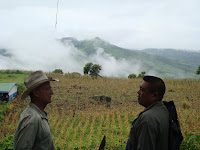
Jaime talking with a community leader in El Curoso

Tuesday, September 30, 2008

Who we are

There's something very soothing about rain falling on a tin roof.  The dull roar becomes a tranquilizer, numbing all your others worries until a trance like stupor is reached, complete with the drool and buddhist-like humming.  It rains a lot here during the rainy season, which I love.  Every time it feels like the city is being washed clean and layers of dirt and stress get purged from my body.

Thank you to all the people who have sent me emails in the past few days.  It's been great to hear from all of you and it sounds like you all are doing well, which I truly hope is the case.  Several people have asked some specific questions about the people, work, ect and so I thought I'd address them in this blog.  Please continue to send any questions you have along...they often give me food for thought.

First, people wanted a little more background on my coworkers and fellow volunteers.  Asofenix is in itself a very small organization, the key to it's success is the strong partnerships it has been able to develop with;  international organizations such as Green Empowerment and Hivos (Dutch program I think), the Nicaraguan government, both locally and within the Department of Energy, and finally with the local communities that need the help but don't know where to go.  All three relationships are vital as without the international aid the money would not exist, without the government the access would not exist and without the communities, well, nothing would get done...or stay done for that matter.  In many ways Asofenix serves as the bridge connecting the resources to the communities, both monetary as well as labor and skill-ish (as in my case).

Right now we are a group of 6.  Jaime, our director is the man.  Period.  Nothing would get done without him.  He taught in rural schools for many years before leaving to study renewable energy systems some 15 years ago and create Asofenix
about 7 years ago.  His time spent teaching in the rural areas allowed him to be able to develop trust with the original communities we worked with.  Trust that has now spread as the success and benefits that the communities experience following Jaime's plan are observed by their neighbors.  His hard work and ability to accomplish goals have also gained the trust of his international partners, with both Hivos and GE signing on to 10 year partnerships.  As for the government, well when constituents are happy so are they.

Seth and Sarah are married volunteers from the Mennonite Central Committee on loan to Jaime for 3 years.  Seth has a masters degree in tropical farming techniques/fauna/I don't really know, but he knows alot about the local agriculture, what they're doing wrong and how to improve their practices.  Sarah is a registered nurse and so she focuses a lot on the health problems, mainly through developing workshops for the communities on proper health techniques and trying to teach them why they get sick.  Seth and Sarah have a house in Bramadero, one of our communities, and thus have had the opportunity to spend considerable amounts of time living and working with them.  As I said before, their knowledge about everything from bus schedules, to do's and don'ts of rural living have been great.  They are both also planning the schedule for the service learning trips that Asofenix sponsors over christmas break, these trips are a good source of income as well as helping the communities and spreading awareness.

Last but not least is Fanny.  Fanny is a Nicaraguan working (not volunteering) for Asofenix.  She has a degree in Mechanical Engineering and worked for two years somewhere else (not very thorough is it).  She makes a lot of our technical presentations and gets a lot of stuff done that it would take a non-spanish speaking gringo like myself months to accomplish.

So we're the core.  There's usually a revolving door of volunteers who are here for 3 months or so working on small projects or lending a hand, but for the most part we're it.

As for how we're viewed in the communities, we're generally very welcomed.  I absolutely love spending time with my family in Candelaria.  They're very open and welcoming, as is the whole community.  We often get what we call the "gringo stare" as we come into a community for the first time but it only lasts for a day or so and usually by the time I leave I'm usually being asked to go help them work in the fields or go visit accompany someone to a friends house in the next village (which I found out was an hour walk...45 minutes after we left).  The only problem I can really complain about is that they feed us too much, and I still don't feel comfortable throwing food away (although I've become adept at feeding it to the dogs when no one is looking).  I think Jaime's presence and connection with the people really helps.  It's nice that we're not a huge organization that just throws money and strangers at a problem.  Instead we live with them and work with them, not for them, making sure they have input in the project and it's done the way they like.  Today for example we had a meeting in Managua of about 20 community leaders to discuss the different systems, what has worked and what hasn't, and to let them share ideas with eachother.  It's their village and their project, we recognize that and I think they in turn respect us more for it.

That's all for now.  Cheers.

Dave

PS - pictures of people to follow.  I have to get to the airport sometime this week though first.

Monday, September 15, 2008

Where am I?

Back by popular request, here's another installment of Dave's World 2008.  I was getting grief from some people about not updating this enough.  I'm flattered, really am, that some people actually care, but just a heads up that this is probably going to be a two to three week between update blog.  Why?  Well, first I won't go so far as to think it's interesting enough to warrant more and then there's always the motivation.  Not that I don't enjoy sharing my experiences with you all but as I like to disagree with all Country Music anyways I'll go ahead and dispute Mr. Atkin's assertion that there's no such thing as too much fun.

So where am I?  I'm in my bed actually, enjoying our freshly minted, hot off the press wireless internet.  I know of certain friends (minus the s) who happen to be in volunteering in India right enjoying, what sounds like, luxury living and Bollywood entertainment (in all seriousness John is doing some awesome work with some very needy kids in India.  Keep it up buddy, you're an inspiration as always).  That's definitely not the case here.  I'm still getting used to shaving with cold water (since hot water heaters don't exist down here), sleeping on plywood, and, well, the novelty of washing my closes by hand was removed much quicker than the dirt...or smell.  Needless to say I'll take my wireless.  In all seriousness though it has taken a little getting used too.  The standard of living down here, even in Managua, is, I don't know, different.  It's not appalling, saddening or deplorable.  I'm just as healthy and happy as ever, as are most of the people I meet.  It's just a different, cheaper way to live.  Also, the quickest way to assimilate myself was to go to the campo (countryside).  One week there and the return to Managua really felt like luxury.  I'm serious, I now feel lucky to have a fan.


I've also been pretty busy with Asofenix, as well as a short excursion to the beautiful Isla De Ometepe (have I mentioned that in a previous post...I'm already losing control of this thing).  We've had several meetings amongst ourselves and with community leaders, some of which were actually fruitful.  I've discovered patience is a wonderful virtue in Nicaragua as guys who ride horses as there only mode of transportation and have no electricity aren't the type to show up on time.  The Son Zapote water pump has been put on hold for at least a week because they're too busy with the harvest.  It appears as though the project will still start sometime in October.  It will be nice to see a completed project and the before and after effects it has on the community.


We also visited San Jose de los Remates, the area where we'll be installing a ridiculous amount of stuff, including at least two micro-hydro systems (22kw and 11kw), some solar electric systems for residences, and it appears a hospital, and most likely a wind turbine project partnered with Blue Energy, another organization that specializes in wind and is based in Blue Fields, Nicaragua.  The civil works for these projects are scheduled to begin early next year which means I'll be busy the next few month evaluating the water resources and energy, sizing the system and helping design/plan out the logistics of the actual construction (Intake system, penstock, power house and electric grid).  It's all relatively new to my fresh out of school brain but thankfully they have people with a lot of experiencing willing to help out.

Finally, I'm also starting to feel a little more at home in Managua.  It still is a little tough to get around (I can't believe no one has EVER made a map of the city bus system).  I still find myself taking 1 hour walks at times because I either a: have no idea where I am or b:  have no idea where that bus goes.  But the more I do figure out the system I'm realizing that the city is much more accessible than I had originally thought. The problem now is actually finding the places I'm looking for once I get there.  Twice now I've arrived in the "area" of where I want to be but because of the lack of any street signs and also addresses, I can't find the restaurant/bar/theater I want to check out even though I'm probably only a block or two away.  Let's just say it's going to be a work in progress.  One of my failed attempts did end up with me eating breakfast at Freddy's house.  I couldn't quite figure out if he actually runs a restaurant or if I was just eating in his living room.  The food was good though, and I got to meet his family which was nice.  Best of all he told which buses to take to get home.

Well so long everyone, until you read again.  Oh, that reminds me.  I know I have a distinct lack of pictures on this blog.  The problem here is that our internet connection is too slow and almost every attempt I have at uploading pictures takes about 4 hours and ends up with a"failure" message.  I've heard the solution to this is to go to the nearby airport and use their free high-speed access.  I will try to do this in the next couple of days and retroactively apply pictures to all my posts.

Saludos,

Dave

Tuesday, September 2, 2008

Managua

I'm beginning to settle into my life in Managua and at intervals I'm finding it both exciting and interesting or extraordinarily frustrating.  My initial thoughts and insights on Managua (if you remember my first post) were about as far off as I could have been.  Yes, the city is extremely poor and life can be very hard for many people.  But I now no longer feel the sense of urgency or frantic commotion I thought existed in, what I now realize, were my exhausted first hours here.  Instead, the city seems to go about its business with a refreshing efficiency of people determined to work and flourish in whatever little nook they've decided to live.  There definitely isn't the luxury and excess that I've become accustomed to back home but isn't really so bad, and the more I get comfortable here the more I realize it isn't necessary.  In someways not having it is a blessing in disguise.  The simple fact is, and I know it's horrible cliche, but simple can often be better.  

The people here are a case in point.  They don't have the luxuries we enjoy and most work harder than any of us can imagine, but nonetheless are very sincere and happy.  They don't share our wealth but also don't share our stupid stresses and worries.  Think about it this way, you wouldn't really give a shit when you got cutoff in traffic if you're just thankful to actually have car.  And saving for retirement worries?  Don't make enough to save and life's a breeze.  Too simple I know, and I also know that the people here have a lot to worry about, but the fact is they worry about what matters.  Who really cares if their plates match their bowls?  The result is a very friendly and open culture.  I get the gringo stare alot but it's not hostile, mainly curious, and I've found a simple hello is often returned with surprising gusto.

The country seems to be doing a lot of improving as well.  This is not an endorsement of any political party, I'll save a discussion of that for later, but roads are being paved, schools built and grids extended all over the country, especially in areas outside of Managua.  Tourism is also starting to increase, as I noticed when I visited the Isla de Ometepe (now in the running as one of the natural wonders of the world).

At the same time this place can be really frusterating.  The lack of organized industry, city planning or even addresses has made it just about impossible for a stranger in the city to get anything done.  What I could have accomplished in a day back home has taken us several weeks and counting.  Take the wind turbine project Calvin and I are working on.  This project consists of simply PVC piping, a saw blade, some screws, scrap metal and a generator, all of which could have been acquired in a day at home for less that $100.  But here the process involves going from one town market or street side shop to the next, digging through old junk, pointlessly trying to explain the difference between DC and AC and often banging our heads against the wall.  The only way we can actually get things accomplished is when Jaime, our Nicaraguan director, personally guides us through the 2 foot wide corridors in the maze of Mercado Oriental, the largest indoor market in central america.  Or when he randomly pulls over on the side of the road to have what turns out to be a makeshift auto mechanic weld our hub and cut us a tower base.  It's frustrating and debilitating to feel completely helpless and a little worthless.  I know this will pass as I become accustomed to the city and more comfortable with the language but for now it's rather irritating.

All in all though things are going well and I'm really starting to enjoy myself.  Our projects are making ssllllooooowwwwww but still steady progress and hopefully will come to fruition.

Thursday, August 28, 2008

To the Hills!

Hi everyone.  You're still here huh?  I must admit that I don't have this blog thing down yet and I think this is kind of a bad rambling mess...but hopefully it will get better in time.

Well alot has happened in the last week but I'm probably not going to talk about it all because I'm lazy.  Maybe tomorrow I'll finish the story.  For now I think I'll just focus on my recent trip to Candelaria.

Our trip started out pretty interesting to say the least.  We were orignally supposed to take a bus from Managua to Teustepe, the capital of the municipality in which Candelaria is located.  From there we planned on switch buses to get to Candelaria.  Due to some logistical errors however, mainly me not knowing what was going on and Calvin not paying attention because he was trying to get my bouncy ball out of the drainage ditch without contracting some deadlly disease, we missed out bus to Teustepe.  We later caught another bus but by the time we got to Teustepe the only bus to Candelaria had already departed.  Fully prepared for a 4-5 hour hike we instead were lucky enough to stumble across a Lechera (milk man) who was driving past Candelaria.  For 50 cents each we hopped in the back with 4 other Nicas (plus one picked up along the way) and proceeded on an hour and a half ride on one of the worst roads I've every experiened (this was two weeks after the government did MAJOR work to fix it up).  Needless to say it was fun.

As for Candelaria itself, I don't think any amount of words or pictures can adequately describe the life these people live.    It is simply something that you have to experience. I'm not an accomplished traveler by any means but I have visited over 10 countries in Europe and several Latin American one's at that.  All I can say is that in all my life this is the only time I have every experienced culture shock in any form.  It is a way of living I couldn't have prepared myself for.  Image turning the clock back a couple hundred years (minus a few modern gadgets like radios and semi-normal clothes
).   The houses are all made of mud/adobe/rock and usually consist of a 15x15 living room and 5x10 kitchen and a 10x10 bedroom for the entire family.  Among the residents of the house are any chickens, pigs, dogs, etc which feel the urge to walk in.  Laundry is done daily on a rock located somewhere in the yard and a shower consisted of going around to the side of the house and pouring a bucket of water on your head.

It's a hard life, there's no denying that.  The family gets up before dawn and the men head to the fields while the women begin there daily chores of cooking, cleaning, laundry and watching the kids.  Cooking is done on an indoor wood stove which means the women must breath in most of the smoke produced by the fire.  The men are  usually gone until nearly dusk working in their fields of corn and beans, often for over 10 hours.  Candelaria is one of the first towns in the city to get electricity which means they can afford to have 1-2 flourescent bulbs to light their home.  Refrigeration or any other more power consuming process is out of the question.  By 8 or 9 pm we were getting ready for bed so we could be up by 4.  Their lives are definately still controlled by the movement of the sun.

Nonetheless, the people are very happy and welcoming.  The simplicity of their lives relieves them of the stresses so often associated with our "progress."  So long as there is enough food and they are healthy, they really are content with their situation.  In fact everyone I talked too would not change their place in life in order to move to a large and "dangerous" city.  They welcome the advantages of technology so long as it does not fundamentally change the lives they lead or the safety and security they feel in their community.  While I believe they appreciate the work we do I no longer in any way feel that I am saving anyone.  Instead it is a simple exchange of services.  In return for pumps and electricity they will bestow upon me a model of simplicity and connection to the earth and to eachother.  A perspective when I feel that life is too busy, too hard or too stressful.

My family for my stay was a riot.  The father Apolonio, and his wife La María, are very patient, welcoming and fun people.  Which is good because they have to handle 5 little ones ranging from 3 to 15 years old.  At this point I must thank Calvin for retrieving my bouncy ball.  That and family pictures were all that got me through the first night when my spanish was literally non existent and I was in complete shock of the world I had entered.  By the end of my 4 days though I felt like I had 5 little brothers and sisters and I can't wait to see them again.  Thankfully though I will be moving into a new house, with my own sleeping space, as their living room wasn't the most convenient place for any of us.

Finally, we did manage to get some work done, believe it or not, as we finished Asofénix's first every biogas digestor, capable (we hope) or producing enough methane gas for cooking through the digestion of cow mierda.  Afterwhich the mierda is steralized and can be used to fertilize fields or gardens.  We also conducted a survey in the nearby town of Sonzapote of 50 houses on their use of water and general health, this will allow us to determine the impact of the solar water pump we will be installing in the village this fall.

Wow.  That's a lot of words.  And I really feel like I left a lot out.  Hopefully it's not too boring and I'll post pictures tomorrow to spice it up.

Saludos,

Dave

Wednesday, August 20, 2008

Bienvenidos a Nicaragua


One day under my belt and it has been pretty quiet, albeit interesting.  Darling, our roomate/unofficial cook made a delicious breakfast of rice, beans and bananas.  A tasty lunch of rice, beans and some sort of meat.  And finally a delicious dinner of rice, the same meat, and cabbage.  I think I'm going to have a pretty steady diet.  She's a great cook though and puts up great with my horrible gringo spanglish.

My home away from home is very much what I expected.....:).  The entire structure is made out of cement and cinder block.  There is no hot water (thank God...who would need it down here) and our stove is a propane two burner camp stove.  We do have a very nice patio and even two working computers.  I share a rather large room and bathroom with Calvin and I really think I can get used to the two inches of foam padding laid over plywood planks which serve as my bed.  All in all I find it pretty cosy and think I'll grow into it.  The pink walls throughout most of the building can only help...right?

I managed to get out into the city a little bit and even went on a quick bus trip.  I really like the bus system here.  It's composed of brightly painted school busses driving down the street with men standing in the door screaming at you to see if you want a ride while the bus driving honks at almost everyone he passes to get their attention.  It works though.  Although the only system we have right now for getting around is to know the general direction you want to go and find a bus going that way.  There are numbers and supposedly they mean something so I'll need to spend a day getting lost so I can figure it out.  You can't really complain when a fare costs the equivalent of 10 cents.

I also met Jaime, the director of Asofenix (who is also very tolerant of spanglish).  He seems like a very nice guy and from what everyone has said is very fun to be around but is also very busy.  Hopefully my spanish comes along quickly so I can communicate more effectively with him.  It was decided after some communication and hand gestures that my trip to the embassy and initiation to the city could be postponed as Calvin is going to Canceleria tomorrow to finish installing a biodigestor and it would be a great opportunity to go with him and meet the people in the village. So no rest for the weary, I'm on my way out tomorrow morning for 3-4 days of ditch digging and village living.  I'm very excited but also very nervous as I feel that all lifelines and support systems will be taken away from me as I leave Managua.  No internet or phone, no looking up words I don't know.  It feels like the deep end but I guess I have to learn how to swim sometime.

Cheers for now.  I'll be back on Monday to hopefully have something more interesting to report.