Sunday, November 16, 2008

Los Elecciones

Election season has arrived to Nicaragua.  And, while certainly not as paradigm shifting and barrier shattering as those in the United States (personally I'm still heartbroken Nader didn't pull it off this time), Nicaragua at least had it's fair share of intrigue.

First a little background, as well as I can determine from talking to co-workers and friends and a little reading (I had to find a good Reagan quote),  Nicaraguan polictics, similar to the US, currently hover between two main political ideologies.  However, whereas we hover between liberal and conservative, they hover between socialist and liberal.  2006, I think, saw the resurgence of Daniel Ortega and the socialist Sandinista Liberation Front (FSLN).  You may remember Ortega and the Sandinistas from the 80's when the US organized and armed a contra movement to remove them from what was then a non-elected Ortega dictatorship (they have just previously overthrown a US supported Somozo dictatorship).  You might remember this little shindig...they call it the Iran-Contra-Affair.  If you don't it pretty much went like this:  CIA sells illegal weapons to Iran, Iran gives US money, US uses money to illegally finance, organize and train contra rebels, Reagan claims to his death that the US support of the "democratic resistance" was justified.  Anyways, in 1984, after defeating the contras, Ortega called for elections (which were and have been monitored ever since by international organizations such as the Carter Center) and ever since Nicaragua has seen a rather stable and fair democracy.

So where was I...oh yeah, 2006, Ortega wins a rather stunning presidencial election with 37% of the vote.  Pretty much the 3 liberal parties split the rest of the votes among themselves allowing him to win in one of those "what just happened" moments.  Still it is deemed a fair election and even President Bush called to congratulate him.  Is Ortega winning a bad thing?  Who knows.  Ortega has definitely moderated his views since the 80's but then again held a meeting with Ahmadenijad two weeks after being elected and has tied himself very closely to Chavez in Venezuela...nonetheless this is still seen as a legitimate democracy.  Two years later we arrive at the November 2008 Municipal elections (mayors, governors, etc), the Sandinistas have been in power for 2 years and there is a general fear that they may like it a little more than the democracy they ushered in over 20 years ago.  This fear is agitated when the Supreme Electoral Council refuses entry, for the first time in Nicaraguan history, to international election monitoring organizations and restricts the movement and activities of NGO's already operating in the country.

The results, the Sandinistas win 94 of the 146 municipal elections, including the coveted Managuan Alcalde.  The results are broadly viewed as fraud by the opposition parties and questioned internationally for several reasons: 1- Marked ballots indicating support for opposition parties are found in dumps near Leon, 2 - Election results show very questionable figures, including some municipalities giving 100% support to Sandinistas or others showing Sandinistas with a slim majority while the remaining parties have perfectly divided the remaining percentage of votes amongst themselves, 3- Supposedly original carbon copies of the Managuan results show the liberal opposition party (PLC) with over 60% of the vote, 4- Prior to the elections the Sandinistas and Ortega had a 26% approval rating.

As you can imagine, a young democracy and it constituents have not handled this ambiguity well.  Below you will find a video of riots in the streets following the elections.  For 3 days immediately after the elections it was not safe to travel widely in Nicaragua or Managua, especially near the principal rotundas.  Sadly there have been a few deaths reported, including the shooting of an 8 year old girl.  While Managua has calmed itself a little, after the Supreme Electoral Council agreed to review the election results here, there is still a lot of turmoil in other parts of the country, mainly Leon, where the Supreme Electoral Council has decided not to review the results.

Whatever you feel about the results or our own election, take the time to say thanks and acknowledge the fact that we are blessed (I'm referring to fellow Amercans...sorry if anyone else is reading this) to have a fair and mature system of democracy where your vote is always counted (Electoral College aside).


Tuesday, November 4, 2008

Bluefields / blueEnergy

HI ALL!!

I know that I've been a little out of touch the past few weeks, and that's because I've been spending the past 2 weeks on the beautiful carribean coast.  No, I wasn't on vacation (although it felt like it at times) but instead Jamie and I attended a conference sponsored by blueEnergy, a Bluefields based NGO focusing on bring renewable and clean energy to isolated communities on the eastern coast of Nicaragua.    The conference was very impressive and educational.  BlueEnergy was able to bring Hugh Piggot, a smallwind guru (one of those those people who are worshipped by the hip/in the know culture).  Hugh actually designed the turbine that blueEnergy uses and came to help them fix some bugs and perfect their design.  In addition Hugh put on a wind turbine conference in which he gave presentations on design issues and then we spent the week actually building a wind turbine from the bolts up.......f#@* me it actually worked!!!!

The conference was absolutely awesome.  The mornings were spent in discussions and presentations among the 6 Nicaraguan renewable energy NGO's, universities, micro credit businesses present.  They were Asofenix, blueEnergy, ATDER-BL, Suni Solar, UNI and Inotec.  Topics for the discussion ranged from renewable energy resources in Nicaragua to community organizing to technical training programs.  I was generally impressed with the ideas, thoughtful consideration and obvious passion that the participants of the conference showed.  I learned quite a bit about the situation of renewable energy development in Nicaragua as well as the future ideas and direction of the movement.  Third world development is a confusing and confounding labrynth in which you can easily lose your way.  It's not simply about providing the resources a community needs, it is also necessary to provide a foundation a community to utilize and effectively safeguard their new resources.  When you consider the isolation and generally low level of literacy, much less education, that exists in these communities simply creating a committee and training a technician to operate the system becomes a daunting task.  But a lot of people are thinking very seriously about solutions to these issues and I felt lucky to be present to listen and share a little.

BlueEnergy itself is also a very very impressive NGO.  Founded 4 or 5 years ago by two brothers and their friend they have their executive headquarters in San Francisco as well as an office in Paris, France.  Their development work is all based in Bluefields where they have over 10 volunteers and 7 Nicaraguan shop persons.  BlueEnergy has spent the past year consolidating it's resources and developing it's infrastructure.  the effort has paid off as they now have an extensive staff, office and resources and the ability to fabricate all of their equipment internally, allowing them to save huge sums of money as well as fabricate their machines much quicker and fix any problems that come up.  The result is that by 2015 they plan to have installed nearly 130 wind turbines.  I think if they show the resourcefulness and resolve they've had over the past few years they now have the ability to do it.  Their long term foresight has paid off.  French volunteers are now my favorite by the way.

As for Bluefields itself, I'm in love.  The caribbean culture is such a unique and fascinated microcosm.  It's amazing how in a 7 hour bus ride, followed by a 2 hour panga (boat) ride (bluefields has no road access) how much a culture can change.  You go from a rather hierarchical and in many ways archaic social structure (I'm trying to say machismo and rigid I think) to this very tranquilo and laid back creoul / caribbean culture.  Reggae and Socca playing in the streets, "Yeah man" being hollered out windows and a general flow to the pace of life....takin it easy man.  The night club was something else as well.  For those of you with a brave heart and who don't blush easily I would highly recommend stopping by 4 Brothers if you're ever in the area.

We also got the chance to visit on of the communities that blueEnergy works with, Monkey Point.  If Bluefields sounds isolated you should see Monkey Point.  it's an amazing place, a 4 hour panga ride from Bluefields and one of the most beautiful and unspoiled areas I've ever seen.....unfortunately that often translates to very poor.

All in all it was a great experience and I feel myself lucky to have been invited.  I made many friends and I hope to make it back sometime very soon.

As for now we have a HUGE amount of work to do with Asofenix.  We had an 8 hour meeting today with community committees and with Asofenix staff where we were able to hammer out the details of the next few months and it is very daunting.  4 major projects, an amazing amount of community organizing, several small projects and repairs and the preparation for two 2 week tourist groups (15 people each) which arrive the 14th of December.  The good news is I feel renergized about the work we're doing and excited that projects are finally coming to fruition....I just wish it was a little spaced out.

I'm going to try to get a post in before the elections here on Sunday, summarizing the political process and the parties involved.  First though I need to learn about it myself so we'll see.  Note that these are not presidential elections but kind of similar to the mid-term elections in the US.

See my new Bluefields/Monkey Point pictures to be posted tomorrow afternoon at:

www.greengringo.shutterly.com


Friday, October 17, 2008

Sounds of Nicaragua

Hi again, I've recorded some interesting, funny, amazing videos of Nicaragua and every once in awhile I'm going to post one or two on my blog.  An ongoing novela of sorts.  Enjoy.

Walking to El Roblar:


Rain on a tin roof:

Sunday, October 12, 2008

What we're doing

Hi again,  sorry it has taken me so long to update my blog.  I guess we've been kind of busy, a lot of traveling to different communities to get the foundations laid out for the upcoming projects.  Overall things are going well, both with work and socially.  I've met some nice people down here to hang out with and I don't quite feel as isolated anymore.  I am though considering buying a motorcycle to get around a little easier, the bus system, while adequate, can be quite agonizing at times.  Also, I figure if I can survive the streets of Managua on a motorcycle I can survive just about anything.

Some people have asked for some more information on the specific projects that I'll be working on over the next few months so I thought I'd take this opportunity to spread a little more light on what we're doing.

Project #1: Solar Water Pump in Sonzapote

Sonzapote is a community of around 350 people.  They are located in a somewhat remote and isolated area of Boaco and currently have to access to running water 
or electricity.  They're sources of water currently include two public wells and a some privately owned wells as well.  Much of the community is located in a part known as "Arriba" and they have to carry their water almost half a mile up a 300 ft climb (when I climbed this myself, with no load to carry I was sweating and out of breath).

So Asofenix has committed to installing a solar water pumping system comprised of 2 tanks that will deliver water to all 70+ houses.  The system will operate by locating a the largest tank above the community and then gravity feeding the water to the community.

So far the well has been dug and the pump/tubes/solar panels/etc have been purchased and site designed.  We are currently waiting for the end of the raining season (end of October) to begin construction on the site.

As with all of our projects the maintainence and repair of the system will be done by the community using a fund that they will create by paying each month a small amount from each family into a general fund that is regulated by the community and saved for a later day.

Project #2:  Microhydro Electric System in El Roblar

I had the pleasure of journeying to El Roblar this week past and in my opinion it is one of the most isolated communities I have ever visited.  Once we had driven as far as we could getting there consisted of walking 2 hours through mud filled "roads" (no car can go up them) and jungle winding paths.  However, once there it is a breathtakingly beautiful area complete
with two waterfalls, perfect for microhydro.  Last week I measured the flow rate of this river and on Wednesday will be returning to measure the head, or total change in elevation, so as to get a measurement on the potencial energy available in the river.  We are currently estimating 10-13 Kw of energy for this site although there are some worries as to the accuracy of this info.
In addition to measuring the potencial energy of the system I am also trying to design (with the help of a generous electrical engineer) a electronic load control system to maintain a constant and full load on the generator by distributing the excess electricity to secondary loads (basically making sure the generator is fully loaded to that there's no fluctuations in voltage or frequency).  The last microhydro system Asofenix completed did not have this sort of control and there have been problems with the distribution grid.

 We plan on starting construction of this project in the beginning of November.  At least with constructing the machine house and the power lines.


Project 3:  La Laguna MicroHydro

I'm not too involved with this project but is going to be going on during the same time as the El Roblar project.  It is a larger system that will be designed for 25 Kw of energy, with the river having a capacity for much more if needed.  If I can successfully design the control system mentioned before it will probably be implemented here as well.

Project #4:  El Curoso Solar Electric Project

Simple but effective project.  A micro loan/finance project in which solar panels are sold to each house in the community and they are then allowed to pay back the principle over the next few years depending on their financial situation.


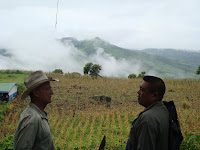
Jaime talking with a community leader in El Curoso

Tuesday, September 30, 2008

Who we are

There's something very soothing about rain falling on a tin roof.  The dull roar becomes a tranquilizer, numbing all your others worries until a trance like stupor is reached, complete with the drool and buddhist-like humming.  It rains a lot here during the rainy season, which I love.  Every time it feels like the city is being washed clean and layers of dirt and stress get purged from my body.

Thank you to all the people who have sent me emails in the past few days.  It's been great to hear from all of you and it sounds like you all are doing well, which I truly hope is the case.  Several people have asked some specific questions about the people, work, ect and so I thought I'd address them in this blog.  Please continue to send any questions you have along...they often give me food for thought.

First, people wanted a little more background on my coworkers and fellow volunteers.  Asofenix is in itself a very small organization, the key to it's success is the strong partnerships it has been able to develop with;  international organizations such as Green Empowerment and Hivos (Dutch program I think), the Nicaraguan government, both locally and within the Department of Energy, and finally with the local communities that need the help but don't know where to go.  All three relationships are vital as without the international aid the money would not exist, without the government the access would not exist and without the communities, well, nothing would get done...or stay done for that matter.  In many ways Asofenix serves as the bridge connecting the resources to the communities, both monetary as well as labor and skill-ish (as in my case).

Right now we are a group of 6.  Jaime, our director is the man.  Period.  Nothing would get done without him.  He taught in rural schools for many years before leaving to study renewable energy systems some 15 years ago and create Asofenix
about 7 years ago.  His time spent teaching in the rural areas allowed him to be able to develop trust with the original communities we worked with.  Trust that has now spread as the success and benefits that the communities experience following Jaime's plan are observed by their neighbors.  His hard work and ability to accomplish goals have also gained the trust of his international partners, with both Hivos and GE signing on to 10 year partnerships.  As for the government, well when constituents are happy so are they.

Seth and Sarah are married volunteers from the Mennonite Central Committee on loan to Jaime for 3 years.  Seth has a masters degree in tropical farming techniques/fauna/I don't really know, but he knows alot about the local agriculture, what they're doing wrong and how to improve their practices.  Sarah is a registered nurse and so she focuses a lot on the health problems, mainly through developing workshops for the communities on proper health techniques and trying to teach them why they get sick.  Seth and Sarah have a house in Bramadero, one of our communities, and thus have had the opportunity to spend considerable amounts of time living and working with them.  As I said before, their knowledge about everything from bus schedules, to do's and don'ts of rural living have been great.  They are both also planning the schedule for the service learning trips that Asofenix sponsors over christmas break, these trips are a good source of income as well as helping the communities and spreading awareness.

Last but not least is Fanny.  Fanny is a Nicaraguan working (not volunteering) for Asofenix.  She has a degree in Mechanical Engineering and worked for two years somewhere else (not very thorough is it).  She makes a lot of our technical presentations and gets a lot of stuff done that it would take a non-spanish speaking gringo like myself months to accomplish.

So we're the core.  There's usually a revolving door of volunteers who are here for 3 months or so working on small projects or lending a hand, but for the most part we're it.

As for how we're viewed in the communities, we're generally very welcomed.  I absolutely love spending time with my family in Candelaria.  They're very open and welcoming, as is the whole community.  We often get what we call the "gringo stare" as we come into a community for the first time but it only lasts for a day or so and usually by the time I leave I'm usually being asked to go help them work in the fields or go visit accompany someone to a friends house in the next village (which I found out was an hour walk...45 minutes after we left).  The only problem I can really complain about is that they feed us too much, and I still don't feel comfortable throwing food away (although I've become adept at feeding it to the dogs when no one is looking).  I think Jaime's presence and connection with the people really helps.  It's nice that we're not a huge organization that just throws money and strangers at a problem.  Instead we live with them and work with them, not for them, making sure they have input in the project and it's done the way they like.  Today for example we had a meeting in Managua of about 20 community leaders to discuss the different systems, what has worked and what hasn't, and to let them share ideas with eachother.  It's their village and their project, we recognize that and I think they in turn respect us more for it.

That's all for now.  Cheers.

Dave

PS - pictures of people to follow.  I have to get to the airport sometime this week though first.

Monday, September 15, 2008

Where am I?

Back by popular request, here's another installment of Dave's World 2008.  I was getting grief from some people about not updating this enough.  I'm flattered, really am, that some people actually care, but just a heads up that this is probably going to be a two to three week between update blog.  Why?  Well, first I won't go so far as to think it's interesting enough to warrant more and then there's always the motivation.  Not that I don't enjoy sharing my experiences with you all but as I like to disagree with all Country Music anyways I'll go ahead and dispute Mr. Atkin's assertion that there's no such thing as too much fun.

So where am I?  I'm in my bed actually, enjoying our freshly minted, hot off the press wireless internet.  I know of certain friends (minus the s) who happen to be in volunteering in India right enjoying, what sounds like, luxury living and Bollywood entertainment (in all seriousness John is doing some awesome work with some very needy kids in India.  Keep it up buddy, you're an inspiration as always).  That's definitely not the case here.  I'm still getting used to shaving with cold water (since hot water heaters don't exist down here), sleeping on plywood, and, well, the novelty of washing my closes by hand was removed much quicker than the dirt...or smell.  Needless to say I'll take my wireless.  In all seriousness though it has taken a little getting used too.  The standard of living down here, even in Managua, is, I don't know, different.  It's not appalling, saddening or deplorable.  I'm just as healthy and happy as ever, as are most of the people I meet.  It's just a different, cheaper way to live.  Also, the quickest way to assimilate myself was to go to the campo (countryside).  One week there and the return to Managua really felt like luxury.  I'm serious, I now feel lucky to have a fan.


I've also been pretty busy with Asofenix, as well as a short excursion to the beautiful Isla De Ometepe (have I mentioned that in a previous post...I'm already losing control of this thing).  We've had several meetings amongst ourselves and with community leaders, some of which were actually fruitful.  I've discovered patience is a wonderful virtue in Nicaragua as guys who ride horses as there only mode of transportation and have no electricity aren't the type to show up on time.  The Son Zapote water pump has been put on hold for at least a week because they're too busy with the harvest.  It appears as though the project will still start sometime in October.  It will be nice to see a completed project and the before and after effects it has on the community.


We also visited San Jose de los Remates, the area where we'll be installing a ridiculous amount of stuff, including at least two micro-hydro systems (22kw and 11kw), some solar electric systems for residences, and it appears a hospital, and most likely a wind turbine project partnered with Blue Energy, another organization that specializes in wind and is based in Blue Fields, Nicaragua.  The civil works for these projects are scheduled to begin early next year which means I'll be busy the next few month evaluating the water resources and energy, sizing the system and helping design/plan out the logistics of the actual construction (Intake system, penstock, power house and electric grid).  It's all relatively new to my fresh out of school brain but thankfully they have people with a lot of experiencing willing to help out.

Finally, I'm also starting to feel a little more at home in Managua.  It still is a little tough to get around (I can't believe no one has EVER made a map of the city bus system).  I still find myself taking 1 hour walks at times because I either a: have no idea where I am or b:  have no idea where that bus goes.  But the more I do figure out the system I'm realizing that the city is much more accessible than I had originally thought. The problem now is actually finding the places I'm looking for once I get there.  Twice now I've arrived in the "area" of where I want to be but because of the lack of any street signs and also addresses, I can't find the restaurant/bar/theater I want to check out even though I'm probably only a block or two away.  Let's just say it's going to be a work in progress.  One of my failed attempts did end up with me eating breakfast at Freddy's house.  I couldn't quite figure out if he actually runs a restaurant or if I was just eating in his living room.  The food was good though, and I got to meet his family which was nice.  Best of all he told which buses to take to get home.

Well so long everyone, until you read again.  Oh, that reminds me.  I know I have a distinct lack of pictures on this blog.  The problem here is that our internet connection is too slow and almost every attempt I have at uploading pictures takes about 4 hours and ends up with a"failure" message.  I've heard the solution to this is to go to the nearby airport and use their free high-speed access.  I will try to do this in the next couple of days and retroactively apply pictures to all my posts.

Saludos,

Dave

Tuesday, September 2, 2008

Managua

I'm beginning to settle into my life in Managua and at intervals I'm finding it both exciting and interesting or extraordinarily frustrating.  My initial thoughts and insights on Managua (if you remember my first post) were about as far off as I could have been.  Yes, the city is extremely poor and life can be very hard for many people.  But I now no longer feel the sense of urgency or frantic commotion I thought existed in, what I now realize, were my exhausted first hours here.  Instead, the city seems to go about its business with a refreshing efficiency of people determined to work and flourish in whatever little nook they've decided to live.  There definitely isn't the luxury and excess that I've become accustomed to back home but isn't really so bad, and the more I get comfortable here the more I realize it isn't necessary.  In someways not having it is a blessing in disguise.  The simple fact is, and I know it's horrible cliche, but simple can often be better.  

The people here are a case in point.  They don't have the luxuries we enjoy and most work harder than any of us can imagine, but nonetheless are very sincere and happy.  They don't share our wealth but also don't share our stupid stresses and worries.  Think about it this way, you wouldn't really give a shit when you got cutoff in traffic if you're just thankful to actually have car.  And saving for retirement worries?  Don't make enough to save and life's a breeze.  Too simple I know, and I also know that the people here have a lot to worry about, but the fact is they worry about what matters.  Who really cares if their plates match their bowls?  The result is a very friendly and open culture.  I get the gringo stare alot but it's not hostile, mainly curious, and I've found a simple hello is often returned with surprising gusto.

The country seems to be doing a lot of improving as well.  This is not an endorsement of any political party, I'll save a discussion of that for later, but roads are being paved, schools built and grids extended all over the country, especially in areas outside of Managua.  Tourism is also starting to increase, as I noticed when I visited the Isla de Ometepe (now in the running as one of the natural wonders of the world).

At the same time this place can be really frusterating.  The lack of organized industry, city planning or even addresses has made it just about impossible for a stranger in the city to get anything done.  What I could have accomplished in a day back home has taken us several weeks and counting.  Take the wind turbine project Calvin and I are working on.  This project consists of simply PVC piping, a saw blade, some screws, scrap metal and a generator, all of which could have been acquired in a day at home for less that $100.  But here the process involves going from one town market or street side shop to the next, digging through old junk, pointlessly trying to explain the difference between DC and AC and often banging our heads against the wall.  The only way we can actually get things accomplished is when Jaime, our Nicaraguan director, personally guides us through the 2 foot wide corridors in the maze of Mercado Oriental, the largest indoor market in central america.  Or when he randomly pulls over on the side of the road to have what turns out to be a makeshift auto mechanic weld our hub and cut us a tower base.  It's frustrating and debilitating to feel completely helpless and a little worthless.  I know this will pass as I become accustomed to the city and more comfortable with the language but for now it's rather irritating.

All in all though things are going well and I'm really starting to enjoy myself.  Our projects are making ssllllooooowwwwww but still steady progress and hopefully will come to fruition.